Springs · Clarington
Garage Door Roller Replacement
A roller near the top corner is riding on the lip of the track rather than inside it, and the section above leans back a little more each week. The door still moves, but it looks one bump away from coming out altogether.
Garage Door Roller Replacement
In plain words
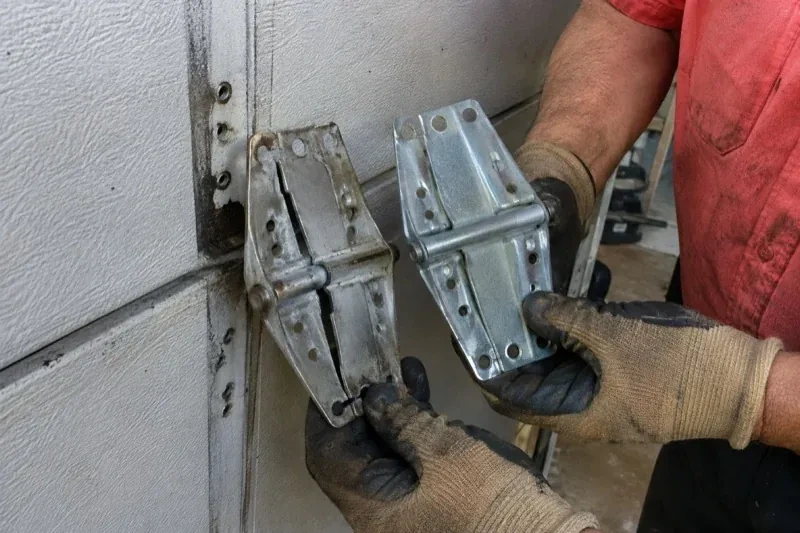
Rollers do more than reduce friction: they are what keeps the door in its track. A wheel worn oval, a bent stem, or a short stem sitting loose in a double hinge lets a section wander until the wheel rides up on the track lip, and from there a door can leave the track altogether. Replacing tired rollers before that point is a small job with a large effect on the door's future. The technician also checks hinge fasteners, jamb brackets and track alignment at the same time, since those are the other pieces that hold the door's path.
How the visit goesSince the cold snap the door has been stiff and noisy first thing, and after the last thaw the bottom corner began to judder. There is slush in the foot of the track and a bloom of rust on the lowest wheel.
Clarington
How the visit goes
Counting hinges and measuring stems
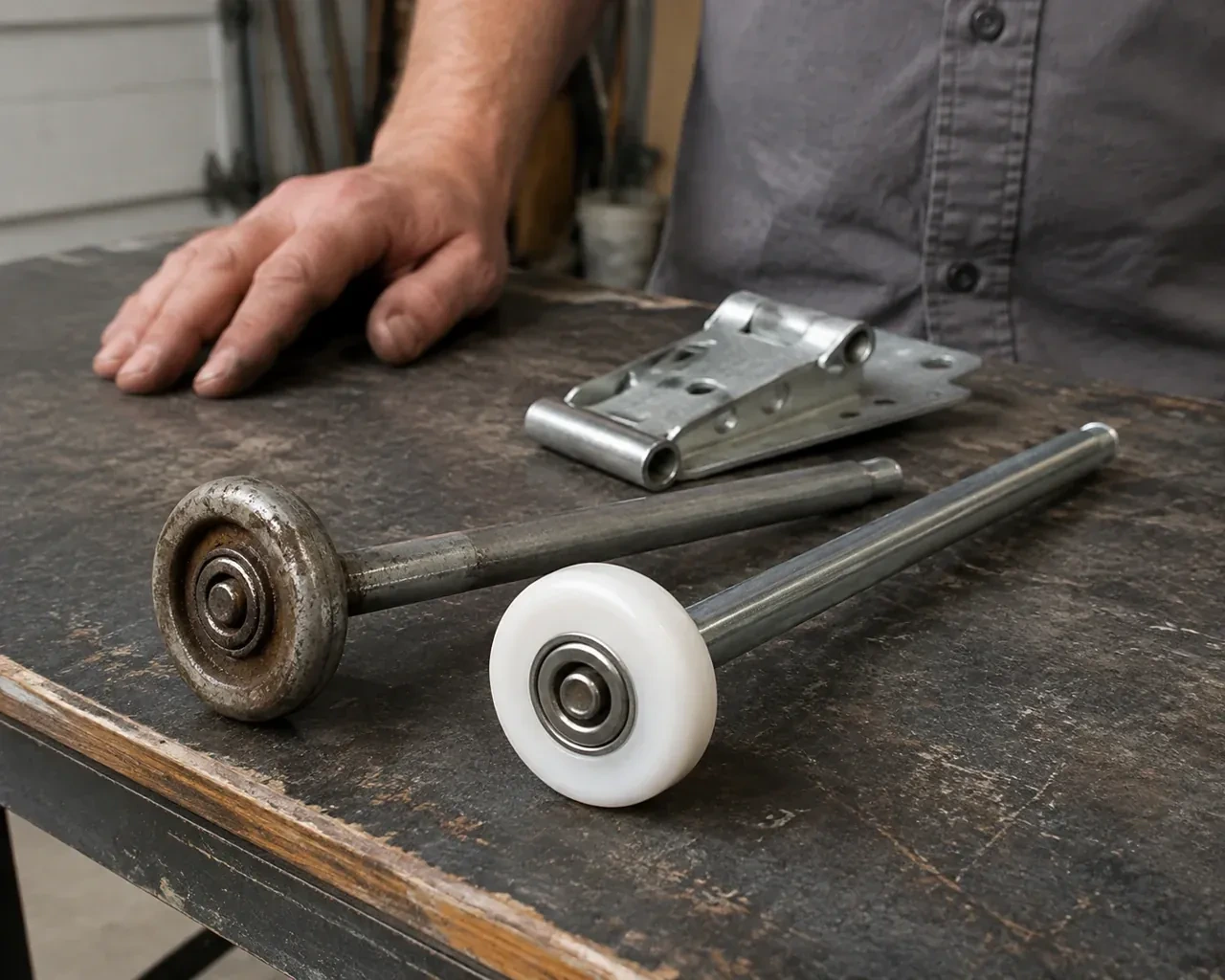
The right replacement depends on numbers taken from your door, not from a catalogue. The wheel diameter is measured across its face: residential track takes a two-inch wheel, while commercial track can take a two-inch or a three-inch wheel depending on the system. The stem is measured from the wheel to its end, and the hinges at each end stile are counted, because a single hinge takes a four-inch stem while two hinges stacked together on a heavier door call for a seven- or ten-inch stem that reaches through both. Stem diameter is confirmed too, since most doors built since the 1980s share one standard size but older doors may not. These measurements decide which set goes in.
Lubricating the right parts, and not the wrong ones
Fresh rollers deserve the right lubricant in the right places. Roller stems and hinge knuckles get a light coat of the door manufacturer's specified lubricant, worked in by running the door a few times. The nylon tire itself is left dry, as is the inside of the track, because grease on those surfaces collects dust and grit that grind the wheel and let it slide instead of turn. Ball bearings are lubricated only where the roller's own maker calls for it, since some nylon rollers should not be greased at all. The technician wipes away any excess so nothing drips onto the car or the floor.
A record of what was fitted
You should know what is on your door. The technician leaves you with the roller type and material, wheel size, stem length by position, bearing count and load rating, along with any hinges, fixtures or brackets replaced and any track adjustment made. Keep this with the owner's manual and the date of the last spring replacement. It answers the questions that come up later, such as which stem length to order if a single wheel is ever damaged, and it lets a future technician see at a glance what the door carries and when it went in.
Garage Door Roller Replacement
In the van
- 1-1/2 inch reversal test block
- Track clamps or locking pliers
- Steel ball-bearing rollers
- Adjustable top fixtures
- Bottom brackets
What affects the quote
Same fees day, night or weekend
1Door height and high-lift track
Tall doors, and high-lift or follow-the-roof track, put the horizontal run high overhead, so ladder work and the extra sections lengthen the visit.
2Number of sections and rollers
A four-section door carries ten rollers and a five-section door twelve; taller doors with more sections, or doors fitted with extra rollers at the top, add to the set, and the quote follows the count.
3Salt and rust in the lower track
A track full of brine, scale and grit needs cleaning before new wheels go in, and heavy corrosion can extend to the brackets and cables, adding to the scope of the visit.
Garage Door Roller Replacement: questions
What is the difference between nylon and steel rollers?
Both are a wheel on a steel stem, commonly on ball bearings though standard nylon rollers can be bearingless; the bigger difference is the wheel material. A steel wheel is tough and suits very heavy or commercial doors, but steel on a steel track is loud and grows louder as bearings wear. A nylon wheel wraps a tire around the hub, absorbing vibration rather than passing it into the track, so the door runs more quietly and the wheel never rusts. For most residential doors, nylon is the usual recommendation.
Can I replace just the one roller that looks bad?
One roller can be changed on its own, and sometimes that is the sensible stopgap after a wheel breaks. The better result comes from a full set, because the other wheels have done the same number of cycles and are close behind, and mixing new with old, or nylon with steel, leaves the door running unevenly and sounding different on each side. A matched set also lets the technician set every top fixture and check every hinge in one pass.
Why does the door shake as it rounds the curve of the track?
The curve is where each roller changes direction under load, so it exposes wear that straight travel hides. A wheel worn oval or flat-spotted bumps as it turns the corner, a wobbling stem lets the section lean back as it enters the horizontal run, and a track whose radius has been knocked out of shape pinches or drops the wheel for an instant. Fresh rollers of the right size in a track that has been checked for shape and spacing usually take the shudder away.
Springs & Hardware
- Garage Door Track Repair or ReplacementBacking out this morning, the mirror caught the track beside the door.
- Garage Door Cable ReplacementThere was a sharp crack from the garage, and when you went to look the door had dropped on one side…
- Torsion Spring ReplacementThe door starts to rise, gets about the height of your knee, then shudders and reverses.
Garage Door Roller Replacement near you
From a stuck door on a winter morning to a planned replacement before the house goes on the market, the services on this page cover what garage doors in Clarington typically need. Each one explains what is checked, how the work is done and what you can expect afterwards.