Openers · Clarington
Garage Door Opener Diagnosis and Repair
The wall button works every time. The remote only works if you are practically under the door; from the end of the driveway it does nothing at all.
Garage Door Opener Diagnosis and Repair
In plain words
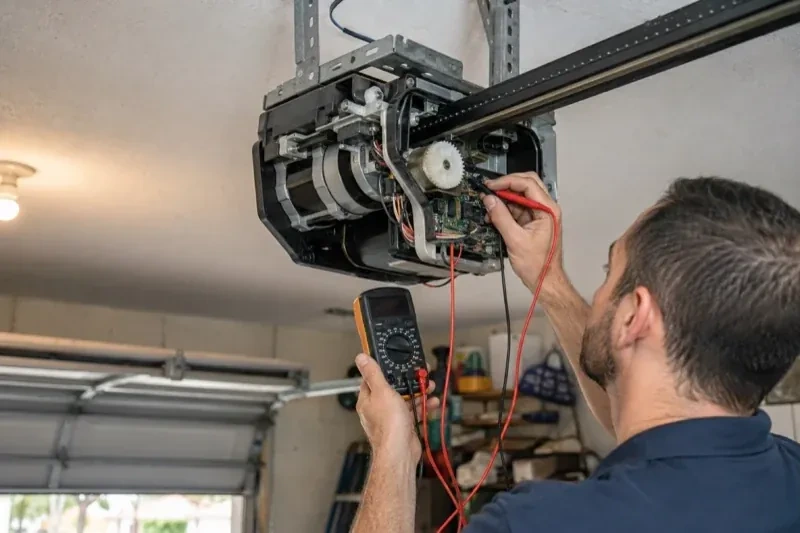
Garage door opener diagnosis is a fault-finding visit with a fixed order of tests. The technician confirms power at the ceiling receptacle, tries each control on its own, checks the safety sensors and their indicator lights, examines the drive train from motor to trolley, and reads any flash code the unit is showing. Only then is a part named, because a dozen different faults look identical from the driveway and guessing at the part costs you a second visit. When the cause is a small component, the repair is made while the technician is there; when it is not, you get a clear account of what comes next.
How the visit goesThe motor runs, the chain rattles along the rail, and the door does not move a millimetre. You notice the little carriage sliding back and forth on its own. Last week the power was out and someone pulled the red cord to get the car out.
Clarington
How the visit goes
The door by itself
With the door fully closed, the technician pulls the emergency release and lifts the door by hand. A healthy door rises smoothly with modest effort, holds still about a metre off the floor, and stays up when fully open. If it is heavy, drifts down, or stays put only at the top, the springs are tired or broken and the opener has been doing work it was never sized for. Tracks, rollers, hinges, cables and drums are looked over at the same time. This check comes before any powered testing, because a door in this state is corrected on the door side first, by someone with the tools for tensioned hardware.
Capacitor and motor work
On an AC opener that hums and clicks but never turns, the start capacitor is the first suspect. It is discharged, tested and replaced with one of the same rating, a routine job that returns a dead-sounding opener to normal in many cases. If the motor still fails to turn with a good capacitor, the technician checks for a seized shaft, burnt windings or a failed thermal cut-out, and confirms the motor is not simply being stalled by a locked or bound door. A motor replacement is weighed against the age of the unit and the availability of the part, and that judgement is explained before any decision.
A clear path if the unit is near its end
When the diagnosis finds an opener that is safe today but not for long, you leave with a plan rather than a surprise. You know which part is wearing, what the warning signs will be, and how the decision to replace is likely to present itself. If the unit is one the industry recommends replacing, such as a head unit with no photo eyes, that is set out plainly along with what a modern belt or direct-drive unit changes: quieter running, battery backup, soft start and stop, and sensors that meet the current standard. The door is left working and safe while you decide.
Garage Door Opener Diagnosis and Repair
In the van
- Start capacitor
- Garage door lubricant
- Photo-eye sensor pair
- Wall control
- Drive gear and sprocket kit
What affects the quote
Same fees day, night or weekend
1Getting in when the door is stuck shut
A garage with no side door and no house connection means working the release from outside before any test can begin, and the quote includes that entry step.
2Type of drive
Chain, belt, screw, direct-drive and wall-mounted jackshaft openers each have their own parts and their own labour; a gear kit on a chain unit is a different job from a coupler on a screw drive.
3Wiring to be re-run
Damaged low-voltage wire to the sensors or the wall control is replaced along its whole length and clipped clear of the track, so the distance and route from head unit to door frame affect the time.
Garage Door Opener Diagnosis and Repair: questions
What do the blinking lights on the opener mean?
They are a diagnostic code. On openers made in roughly the past fifteen years, the head unit flashes its lights, or a pair of up and down arrows, in a counted pattern such as one flash then five. Each pattern corresponds to a fault family on the maker's chart for that model: sensor circuit obstructed or open, motor commanded but not moving, more force than allowed. The technician reads the pattern, then confirms it by hand, since one fault can imitate another.
Why will the door close only while I hold the wall button?
That is a built-in behaviour, not a new fault. When the sensor circuit reports a problem, most openers refuse to close from a remote but allow a constant-pressure close from the wall control, because someone standing there can see the doorway. It is a strong signal that the photo eyes or their wiring need attention, and once the sensor issue is corrected the door closes normally from every control again.
Why does the door stop just above the floor and reverse?
Two usual reasons. The travel limit is set a fraction too long, so the door reaches the slab, meets it harder than expected and interprets that as an obstruction. Or the bottom seal has stiffened or frozen and the last few centimetres take more force than the setting allows. Both are adjusted after the door is checked for balance, and the fix is confirmed by closing the door several times and running the contact reversal test.
Openers & Access
- Belt-Drive Opener RepairIt is minus twenty in the detached garage and the door climbs in jerks, the belt stiff as a board.
- Garage Door Opener ReplacementPress the button and the motor hums, but the door stays exactly where it is.
- Photo-Eye Sensor Alignment or ReplacementSomeone backed the car in a little too far, a bin or a bicycle brushed the track, and since then…
Garage Door Opener Diagnosis and Repair near you
From a stuck door on a winter morning to a planned replacement before the house goes on the market, the services on this page cover what garage doors in Clarington typically need. Each one explains what is checked, how the work is done and what you can expect afterwards.