Openers · Clarington
Belt-Drive Opener Repair
It is minus twenty in the detached garage and the door climbs in jerks, the belt stiff as a board. By the afternoon, when the sun has been on the door, it runs almost normally again.
Belt-Drive Opener Repair
In plain words
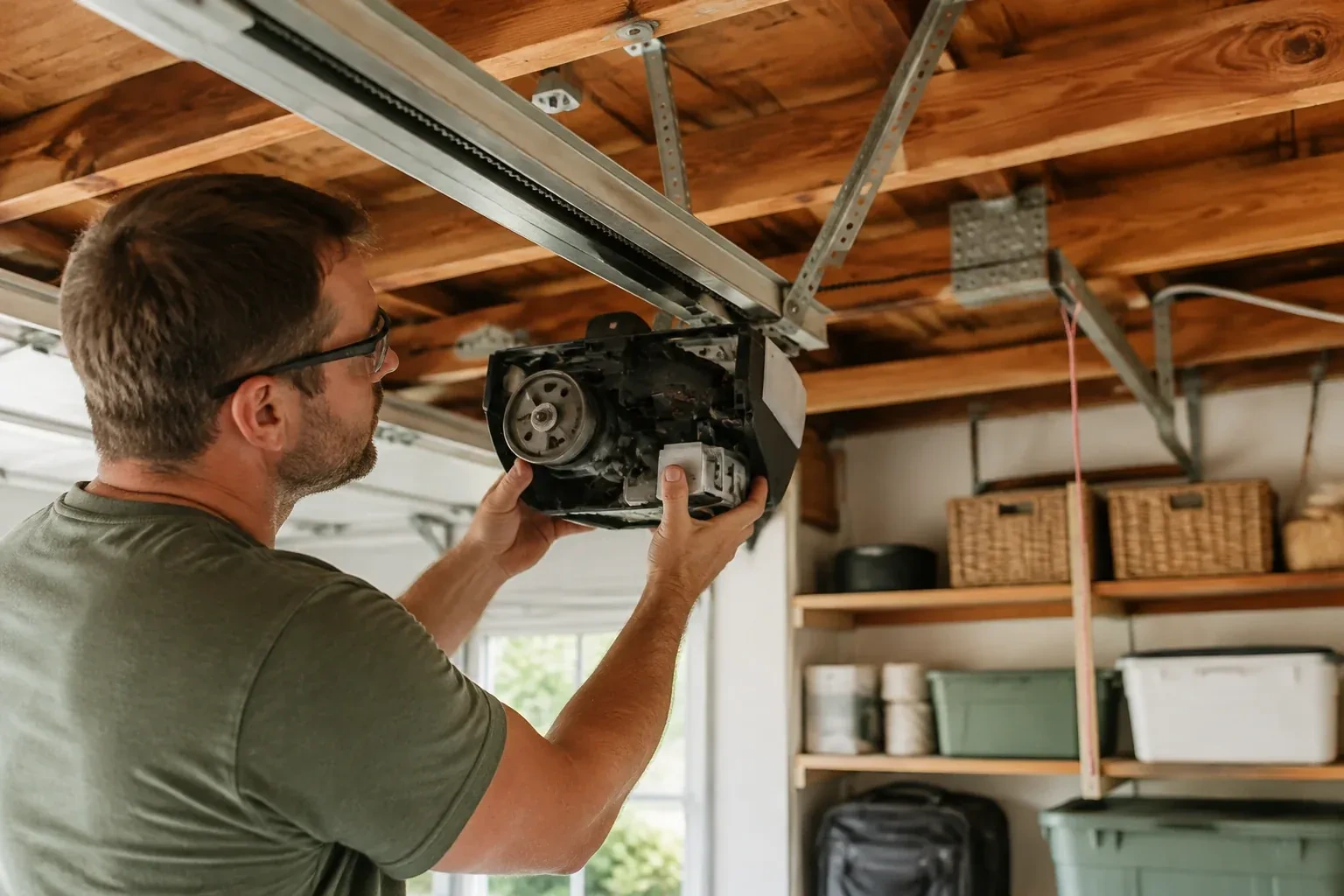
A stalled belt drive is often a trolley problem, not a belt problem. The trolley rides the rail in two halves: an outer part linked to the door arm and an inner part gripped by the belt. Pulling the red cord parts them so the door can be lifted by hand; running the operator, or a second pull, locks them again. When the release lever sticks, the housing cracks or the halves refuse to re-engage, the motor moves the belt and nothing else. Repair means freeing or replacing the trolley, checking the belt for damage from the drag, and confirming the inner half is in step with the motor.
How the visit goesSomeone tightened the belt last month to stop the sag. Now the opener sounds like a chain drive, the motor labours on the way up, and the whole rail vibrates under the ceiling.
Clarington
How the visit goes
Reading the belt from end to end
With the trolley run to one end of the rail and then the other, the whole length of the belt passes under the technician's eye and fingers, on the top run and the return. What they are looking for is specific: cracks across the back of the rubber, a glazed shine that says the belt has been slipping, an edge gone fuzzy from rubbing, a stretch where the teeth are flattened or torn away, cords showing through, and the state of the clip or link where the belt meets the trolley. Each of these points to a different cause as well as a different repair, and where the wear sits along the belt says a lot about which.
Putting motor and trolley back in step
Any time the belt has been off the sprocket, the operator's sense of where the door is can drift from where the trolley actually sits, so this step is done before the door is reconnected. The technician lifts the belt clear of the sprocket, runs the operator until the sprocket turns to its closed position and stops on its own, then slides the trolley to the closed end of the rail and refits the belt. Motor and trolley now agree. On operators with a mechanical limit assembly, the middle contact is adjusted instead. Without this step, the door stops short at one end no matter how the travel limits are turned.
The two tests you do each month
The repair ends with the reversal tests run in front of you, and they are yours to repeat monthly. With the door fully open, lay a scrap of 2x4 flat on the floor where the door meets it, press the wall control and watch: the door should touch the wood and climb back to the top. Then, with the door closing, pass a broom handle through the beam near the floor; it should reverse the same way. Both take under a minute. If either test ever fails, stop using the operator, work the door by the red cord, and have a trained technician check it; the fault can be the settings, the sensors, the wiring or the opener itself.
Belt-Drive Opener Repair
In the van
- Idler pulley and bearing
- Rail joint brackets and stop bolts
- Photo-eye sensor pair
- Garage-door lubricant for hinges and rollers
- Belt tension spring and square nut
What affects the quote
Same fees day, night or weekend
1Belt length and type
A belt for an 8 ft door rail is longer than one for a 7 ft rail, and belts differ by maker and tooth pitch, so the part named on the quote follows the operator's model.
2Height of the ceiling
Where the operator hangs under a tall or vaulted ceiling, the sprocket and idler are reached from taller ladders and the work at the head takes longer.
3Trolley condition
A trolley that releases and re-engages cleanly stays. One that is cracked, stuck or loose on the rail is replaced during the same visit and listed as its own part.
Belt-Drive Opener Repair: questions
How do I know the belt is the problem and not something else?
Look and listen. A belt that hangs below the rail, slaps on the way up or clicks at the same point each cycle is a belt fault. A motor that runs with the door still might be a broken belt clip, a stripped gear or a belt off the sprocket. A door that is heavy when you lift it by hand with the operator released is a spring matter. The technician confirms which before any part is ordered.
How long should a belt last once repaired?
A belt's life is counted in cycles and years, and on a balanced door with the rail straight and the tension right it runs for many years. What shortens it is a heavy door, an over-tight adjustment, a bent rail rubbing one edge, or grease on the rubber. Keep the door balanced and lubricated, the belt dry, and glance along the rail a few times a year.
Can I adjust the belt tension myself?
The adjustment nut is reachable and some owners do, but there are two things to get right. The operator must be unplugged and the door released first, and the spring must be set to the maker's length rather than tightened until the sag disappears, since an over-tight belt is noisy and hard on the motor. After any change, the reversal tests should be repeated. Many people prefer to have it done during a service.
Openers & Access
Belt-Drive Opener Repair near you
From a stuck door on a winter morning to a planned replacement before the house goes on the market, the services on this page cover what garage doors in Clarington typically need. Each one explains what is checked, how the work is done and what you can expect afterwards.